What have we done…?

In the past, one of the uses of this blog has been to document the changes and additions we have made to VetBact. In recent years, however, we haven’t blogged much about anything, to be honest. Does that mean that nothing has changed? One might be tempted to surmise that the website has reached some level of maturity which in turn might lead to a lower rate of change. There may be some truth in that in the sense that it already contains much of the material that is needed for the courses in veterinary bacteriology and other related subjects where VetBact is used here at SLU. A supplementary explanation is probably that in recent years we have simply had less time to work on the further development of this site. And on writing blog posts.

However, this does not imply that nothing has changed and here are a few things we have added since the most recent blog post in 2023:
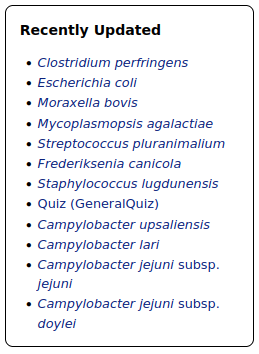
Recently updated pages, 30 Dec. 2025.
  • In 2024, we introduced a new section on susceptibility testing. We describe three fundamentally different types of such testing and you may want to check them out, if you’re not familiar with them already.
  • In 2025, it became clear that major web browsers were dropping support for the Ogg/Theora video format which we used for video clips on the website. We solved this by converting the clips to WebM format, which is also Open Source. The video clips on VetBact are used to illustrate motility. For example, check out Brachyspira hyodysenteriae.
  • In both years, as well as earlier, we have updated information in already existing sections. This work may not be obvious but if you take a look at the front page, there is usually a list displaying the most recently updated pages. The figure (right) shows the list as it appeared on 30 December 2025.

That’s it for 2025. Welcome back in 2026!

Posted in General, Updates | Leave a comment

New names of bacterial phyla

Names of the category “phylum” in the taxonomic hierarchy of bacteria were earlier not regulated in the [International Code of Nomenclature of Prokaryotes (ICNP)]. However, in February 2021, the members of the International Committee on Systematics of Prokaryotes (ICSP) have decided that naming of phyla must also be regulated in ICNP. The new names of 42 bacterial phyla were published in an article entitled: Valid publication of the names of forty-two phyla of prokaryotes by Ahron Oren and George M. Garrity. The following rules are important for naming of phyla:

There is a later edition (2008) of this book.


1. In the names of phyla, -ota must be used as the ending.

2. Italics must be used for names of phyla in text.

3. A phylum name must be based on a genus, which constitutes the nomenclature type of the phylum in question.

Posted in Taxonomy/Phylogeny | 1 Comment

New families within the order Enterobacterales

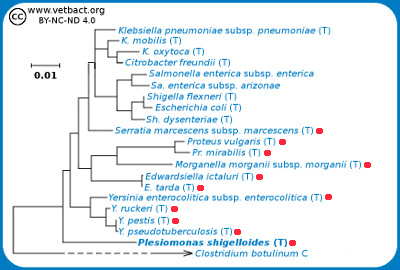
Phylogenetic tree with certain species within the order Enterobacterales. Species affected by the new family names are marked with red dots.

The order Enterobacterales (formely called Enterobacteriales) is a large taxon containing many bacteria of veterinary importance. The members of this taxon have different properties and form a number of distinct phylogenetic groups. Six new families have now been introduced within the order Enterobacterales, which makes the new taxonomy to better reflect the phylogeny of this group. These new families are: Budviciaceae, Erwiniaceae, Hafniaceae, Morganellaceae, Pectobacteriaceae and Yersiniaceae. Four of these families are represented on VetBact and the genera that are relevant are indicated within parentheses for the respected family: Erwiniaceae (Pantoea), Hafniaceae (Edwardsiella), Morganellaceae (Morganella and Proteus) and Yersiniaceae (Serratia and Yersinia). The bacterium Plesiomonas shigelloides has not yet been assigned to a new family and therefore, it stands as inserta sedis. For more information, see article by J. M. Janda & S. L. Abbott.

Posted in Taxonomy/Phylogeny | Leave a comment

Revised taxonomy of mollicutes (mycoplasmas)

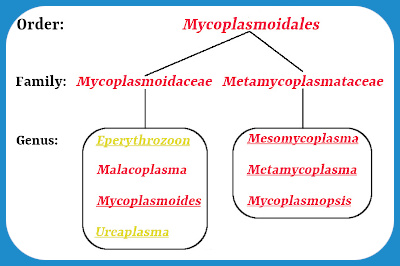
Taxonomy of the new order Mycoplamoidales of the class Mollicutes. New taxa are written in red. For a complete figure, see Taxonomy of mollicutes (mycoplasmas) in VetBact.

The taxonomy of the mollicutes (mycoplasmas) has finally been revised thanks to a Canadian and an Israeli research group. This revised taxonomy is based on data from whole genome sequencing of 140 mollicutes. Only members of the so-called mycoides group are still included in the order Mycoplasmatales. Other former members of this order have now been transferred to the order Mycoplasmoidales. This new order Mycoplasmoidales has been divided into the two families Mycoplasmoidaceae and Metamycoplasmataceae, which have been further subdivided into five different genera (see figure). The important purpose of the revision of the taxonomy of the mollicutes was to get a taxonomy that reflects the actual phylogeny of these bacteria. Read more about this new taxonomy in the term list of VetBact under Taxonomy of mollicutes (mycoplasmas).

Posted in Taxonomy/Phylogeny | 2 Comments

The bacteriology course for Swedish veterinary students, 2021

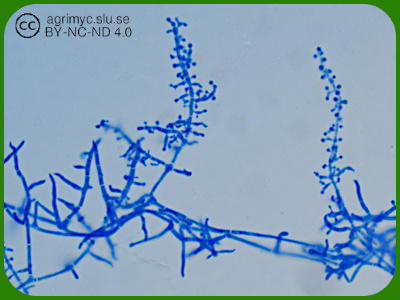
Micrograph of hyphae from the dermatophyte Trichophyton mentagrophytes. Photo Ann-Louise Bergefur (SVA).

The bacteriology course for the Swedish veterinary students starts on September 16 and we would like to wish the students very welcome to this course. We hope that the students will find VetBact and the new resource AgriMyc useful during their studies and especially since the lectures will be on-line due to COVID-19. AgriMyc is a database with information about fungi that are of interest in agriculture and veterinary medicine(see previous blog post). We appreciate all kinds of feed-back, which will help us to improve the databases VetBact and AgriMyc as well as their different parts. We strive hard to make the two databases as useful as possible for the visitors.

/The VetBactRef Group

Posted in Events | Leave a comment

AgriMyc – a new resource from SLU

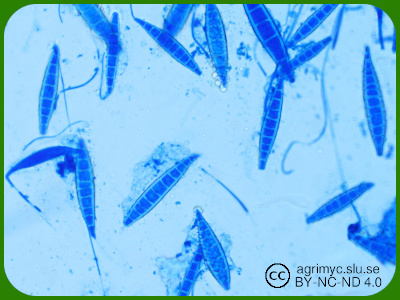
Micrograph of macroconidia from the dermatophyte Micrococcus canis. Photo Ann-Louise Bergefur (SVA).

AgriMyc, which is a new “sister page” to VetBact, has recently been launched from the Department of Biomedical Sciences and Veterinary Public Health at the Swedish University of Agricultural Sciences (SLU). This new website is based on a database containing information about fungi that are if interest in agriculture and veterinary medicine. The primary goal of this site is to be useful for students within these and related fields. So far, 45 different fungal species and subspecies have been included, but the information on the different fungal pages is far from complete. We will keep working on AgriMyc by adding more species and improve the information on the pages to make it useful for the visitors. We sincerely hope to get input from visitors by the contact form. To reach it, click on “Contact” on any of the fungal pages.

Posted in Events | Leave a comment

1 000 000 visited pages

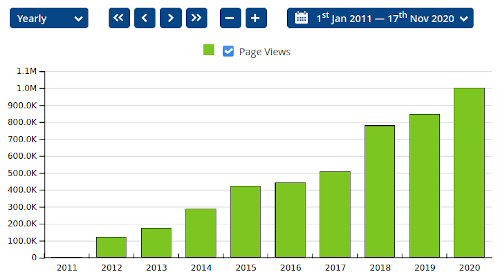
Today (2020-11-17) we have reached 1 000 000 visited pages on VetBact since 2020-01-01. This is the largest number we have experienced since VetBact was registered at StatCounter in November 2011. The image below shows that the number of visitors has increased by an average of about 100 000 per year.

Number of visited pages of VetBact per year. The graph has been adapted from StatCounter.

The VetBact Reference Group

Posted in General | Leave a comment

Outbreak of CODD in southern Sweden

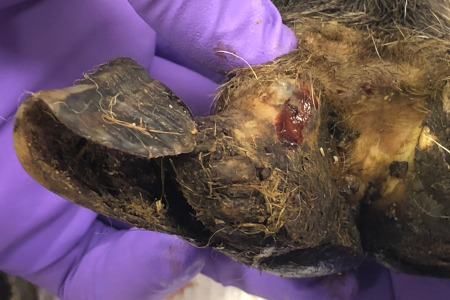
The image shows the hoof from a sheep suffering from contagious ovine
digital dermatitis during the recent outbreak in southern Sweden.
Photo: Sara Frosth

A second case in Sweden of Contagious Ovine Digital Dermatitis (CODD), has during the autumn
2020 been demonstrated in southern Sweden. The first case was detected in Sweden in early 2019. CODD is a painful and difficult-to-treat bacterial infection in sheep. First the infection affects the area along the coronary band, then the infection spreads under the hoof horn and can cause detachment of the hoof capsule. CODD is very difficult to treat and is a major problem for sheep farmers in some countries such as the UK. The cause of the disease is not entirely known but Treponema spp. has often been detected in sheep with CODD and sometimes together with Fusobacterium necrophorum and Dichelobacter nodosus.

Sara Frosth & Ingrid Hansson

Posted in Outbreaks | Leave a comment

Changing Bacterial Names

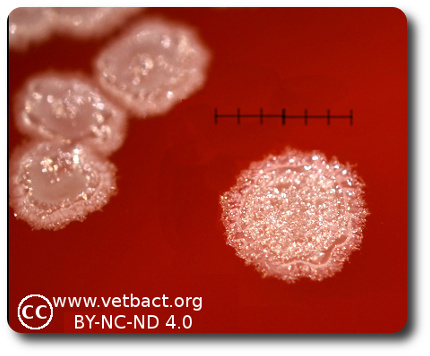
Rhodococcus equi
Close-up of colonies of Rhodococcus equi cultivated on bovine blood agar. The length of the scale bar is equivalent to 5 mm.

The scientific names of bacteria are changed from time to time and some of them, several times. This may cause confusion, but one should keep in mind that any bacterial name that has been validly published for a certain species may be used in scientific literature. The names must be unique and linguistically correct. Furthermore, they should preferably reflect the relation to closely related species, by having the same genus name. Systematic bacteriology is a rapidly developing scientific field and new pieces of knowledge are continuously obtained. Therefore, recently validly published scientific bacterial names are more likely to reflect the true properties of the bacterium, than older names.

One example of a bacterium that has caused confusion is Rhodococcus equi. There has been an ongoing debate since the1980s, if this bacterium should not be called Rhodococcus hoagii or Prescottella equi, which both have been validly published. In VetBact we have chosen to use Rhodococcus equi because the veterinarians in our area were not very happy with the other names.

In the list of bacterial names in VetBact, you can only find Rhodococcus equi. However, if you perform a Quick Search in VetBact and use the other names of this bacterium, you will arrive at the correct species. This also applies for other bacteria that have more than one validly published name.

Posted in General | Leave a comment

The bacteriology course for Swedish veterinary students, 2020

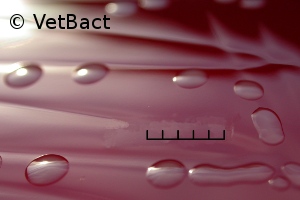
Close-up of colonies of Bacillus licheniformis which has
recently been included in VetBact. The length of the scale bar is equivalent to 6 mm.

The bacteriology course for the Swedish veterinary students starts on September 17 and we would like to wish the students very welcome to this course. We hope that the students will find VetBact useful during their studies and especially during this year, since all lectures will be on-line due to COVID-19. We appreciate all kinds of feed-back, which will help us to improve VetBact and its different parts. During the last year we have included several new bacteria, and more quizzes have been added in the course material. We are continuously updating information of bacteria, terms, biochemical tests and growth media etc.

The VetBactRef Group

Posted in Events, New bacteria for VetBact | Leave a comment